A trailer is a significant investment, so it’s natural to take your time shopping around and comparing options before you commit. But if you’re planning to use your trailer for very specific applications, like transporting a race car, housing a mobile business, or serving as a command center at events, you’ll likely find that a standard model won’t be up to the task.
Customizing your build from the wheels up ensures it has everything you need for the job and prevents you from having to compromise on things like storage, layout, accessibility, or power. With custom trailers, you get full control over everything from the frame and axle configuration to the interior layout and finish work.
A Step-by-Step Guide to Designing Custom-Built Trailers
A high level of personalization is what separates custom-built trailers from a standard one you settle for. Here’s how to start designing yours:
1. Define Your Operational Needs
Before selecting a frame size or setting a budget, map out every task your custom trailer must perform.
Start by considering these five factors:
- Cargo Specifications: Determine the length, width, height, and overall weight of everything going inside, as well as sensitivity to temperature (which dictates climate control needs).
- Travel Frequency and Distance: Decide whether the trailer will primarily cover long highway stretches or remain stationary as a mobile workspace.
- Workspace vs. Living Quarters: Define whether you need dedicated workshop space, living quarters (sleeping, cooking, bathroom), or a hybrid layout.
- Duration at Destination: Plan for power and climate requirements based on how long the trailer stays parked on site during events or projects.
- Regulatory and Venue Constraints: Account for venue size limitations, track rules, or local road permit restrictions.
Special Considerations for Custom Race Trailers
Transporting low-profile race vehicles, dedicated track crews, and essential gear requires a level of customization and functional organization that standard cargo trailers simply cannot provide.
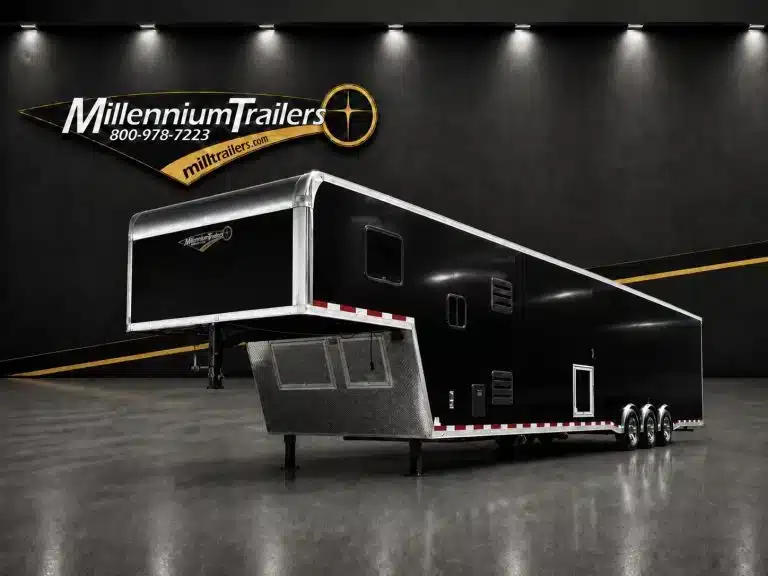
Building a custom race trailer gives you complete control over every structural detail and interior layout feature, ensuring your build is configured specifically for your vehicle’s dimensions and your team’s trackside workflow, including:
- Dedicated Vehicle Bays: Dimensioned for specific car models, with tie-down placements matched to the vehicle’s frame points
- L-Shaped Workbenches and Overhead Cabinets: Provide a full trackside workspace with organized storage for tools, parts, and racewear above
- Generator Compartments: Housed within the cabinet configuration to keep power accessible without cluttering the floor plan
- Escape Doors: Positioned to allow exit from the vehicle after loading; cars positioned over wheel wells often limit door clearance without this feature
- Beaver-Tail Ramps: Reduce the entry angle during loading to protect low-clearance vehicles from scraping the threshold
- Living Quarters: Ideal for multi-day events; gooseneck models can be outfitted with sleeping areas, kitchenettes, and even complete living setups
2: Choose Between Enclosed or Open
Deciding whether to go with an enclosed or open configuration depends on what you’re hauling and how much protection it requires.
With enclosed designs, you get:
- Full weather protection for vehicles, equipment, and cargo in transit
- Better security when the trailer is parked overnight or stored between events
- Interior space to add shelving, cabinetry, lighting, and electrical systems
Open trailers offer:
- Lower overall weight for easier towing with smaller tow vehicles
- Faster, unobstructed loading and unloading
- Lower entry cost for simple applications where protection isn’t a priority
For valuable or weather-sensitive cargo, custom-built trailers with enclosed designs offer better long-term value and maximum protection. Meanwhile, open configurations are the right call when weight savings and quick access take priority over security.
3. Pick a Size
With trailers, bigger isn’t always better. The right size is the one that provides sufficient room for your cargo and workflow without adding unnecessary weight.
Before choosing a longer or wider build, consider the trailer’s:
- Expected loaded weight
- Interior height
- Ramp dimensions
- Storage needs
- Parking limitations
- The tow vehicle’s payload and towing rating
The table below covers common configurations for custom trailers and their typical applications:
| Trailer Size | Common Use | Key Consideration |
| 6×12 bumper pull | Single motorcycle, light cargo | Towable by most SUVs |
| 7×14–7×16 bumper pull | One vehicle, contractor gear | Versatile all-purpose size |
| 7×20–28 bumper pull | Single vehicle + storage | Common for racing or car shows |
| 30’–36′ bumper pull | Two to three vehicles | Requires heavy-duty tow vehicle |
| 20’–40′ gooseneck | Multi-vehicle, heavy equipment | More stable at highway speed |
| 48’–53′ gooseneck | Commercial or stacker setups | Largest available configuration |
Additional height creates clearance for tire racks, helmet storage, and larger overhead cabinets, so be sure to specify if you’re planning a racing or professional build.
Always confirm that your trailer’s weight rating matches your tow vehicle’s rated towing capacity before locking in a configuration.
4: Decide on the Material for the Frame
Frame material affects weight, longevity, and how the trailer holds up under the specific stresses of your application. Aluminum and steel are the two options builders typically work with.
Aluminum frames’ advantages include:
- They weigh less than steel, which improves towing ease and fuel economy over long distances.
- They resist rust and need minimal maintenance over the life of the trailer.
Meanwhile, steel frames hold their own in these areas:
- They can carry heavier loads under high-stress, high-repetition conditions without flexing.
- Standard shop equipment can weld and repair steel, which keeps repair costs down.
- Contractors and heavy equipment haulers often choose steel, since structural durability takes priority over weight savings.
Weight savings are a top reason why many motorsports and long-haul vehicle transport builds are made of aluminum. Durability under demanding, high-load conditions makes steel the better fit for heavier or more localized hauling.
5. Pick Your Interior Upgrades
Interior features are what turn a bare frame into a highly functional space, allowing you to tailor the layout to your workflow.
Some features to consider adding to your build are:
- Flooring: Options include TPO coin flooring (the most popular choice for durability and traction), aluminum tread plate, marble vinyl, checkerboard vinyl, and extruded aluminum plank.
- Lighting: LED interior systems make it easier to load in low-light conditions or work inside at night.
- Electrical Systems: Choose from shore power connections, a generator hookup, or full 110V interior circuits, depending on your power needs.
- Custom Storage and Tool Organization: Inset E-track or L-track tie-down systems along the floor and walls to provide flexible anchor points for compatible straps and fittings. Wall-mounted tire racks, helmet cabinets, and fold-down workbenches help keep equipment organized while preserving floor space.
- Climate Control: Adding insulation to the walls and ceiling, paired with a roof-mounted A/C unit with a heat strip, keeps the trailer usable year-round.
- Tie-Down Systems: Recessed D-rings offer fixed anchor points, while E-track allows you to run the entire length of the trailer and tie-down at any position along the strip.
- Winch Systems: Electric winches simplify loading vehicles or equipment that can’t be driven under their own power.
How the Custom Trailer Design Process at Millennium Trailers Works
Knowing what to expect from inquiry to delivery helps with planning and budgeting. Here’s how our customization process works at Millennium Trailers:
- Complete the Design Survey: The “Design Your Own Trailer” survey asks about hitch type, length, width, living quarters preferences, and other options. You provide contact information at the end so we can reach out to you to discuss your needs further.
- Connect with a Design Specialist: A specialist reviews your responses and sends a custom quote with line-item pricing, so you can see the cost impact of every individual option before committing.
- Refine and Finalize the Quote: The quote is adjusted until it reflects exactly what you want. A fair discount is applied upon finalization.
- Engineering Fee and Blueprint: A small engineering fee is required to proceed. That fee is subtracted from the final purchase price. You’ll receive a blueprint and a final signed quote.
- Build Scheduling: Once documents are signed and the deposit is submitted, your trailer enters the production schedule. The factory provides a build timeline estimate based on current conditions.
- Delivery or Pickup: When the build is complete, Millennium will contact you for the remaining balance. Title paperwork arrives by registered mail within approximately 21 days of delivery.
Start Building Your Dream Trailer With Millennium Trailers
Whether you need a trackside race trailer, a commercial work setup, or a collector car hauler, a custom build ensures your trailer matches your exact application.
Millennium Trailers has been building and distributing custom trailers since 1998, delivering to customers across nearly every state in the country. Our stock range includes everything from bumper-pull enclosed trailers for single-vehicle transport to fully outfitted gooseneck builds with living quarters for extended race events.
Call 1-800-978-7223 or submit the contact form to begin designing your trailer today.