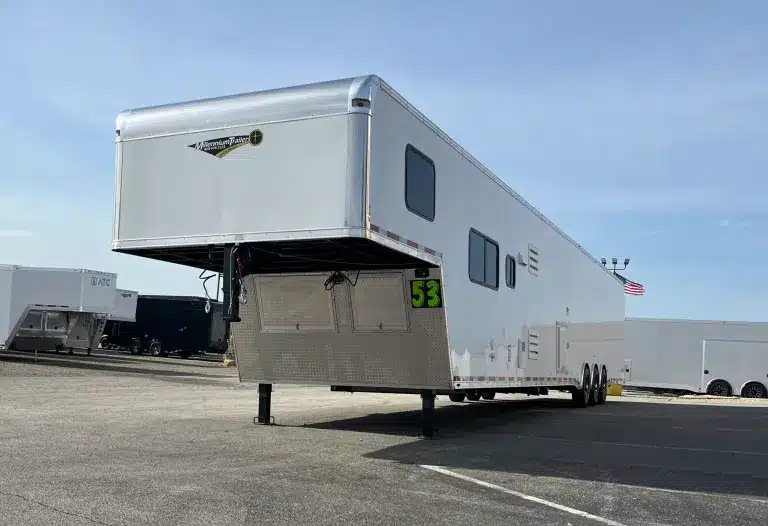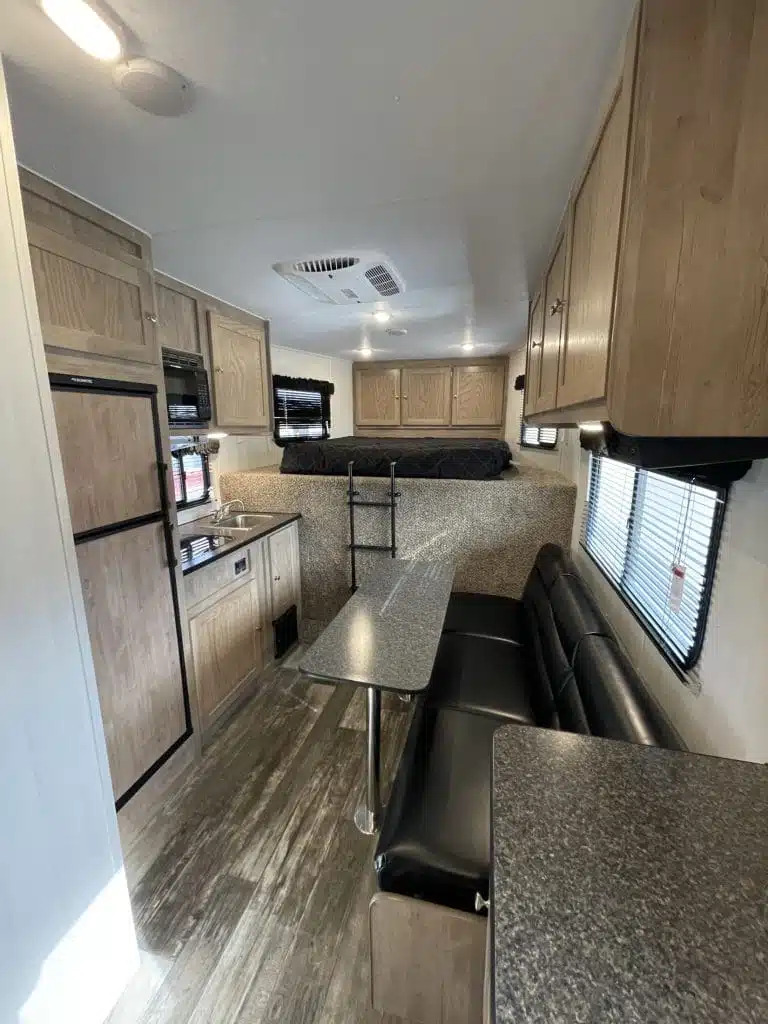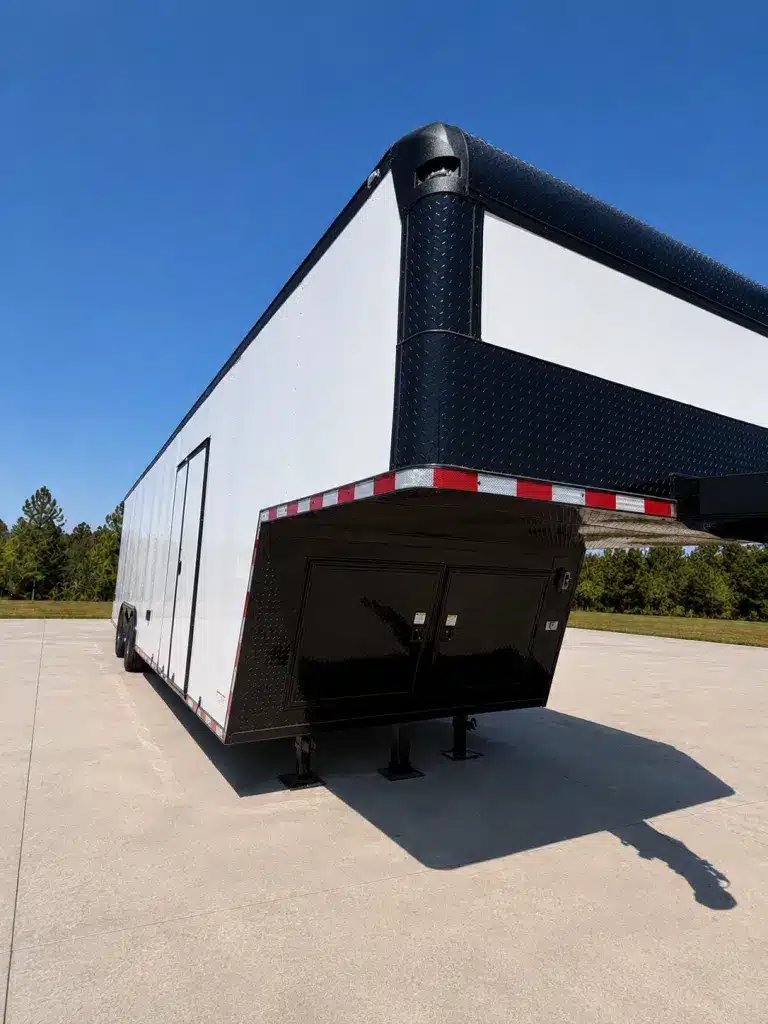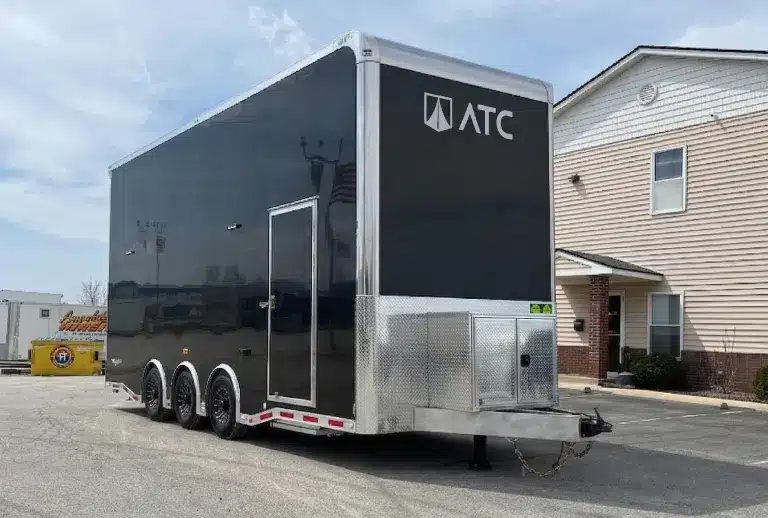


Properly loading and securing your vehicle on a gooseneck trailer ensures safe transport, balance, and stability as you maneuver on the road. When executed properly, the trailer handles well at highway speeds, protecting your vehicle and equipment during transport.
Below, we’ll cover each step of the loading process so you can safeguard your cargo while using a gooseneck trailer. You’ll learn how to secure a car on a gooseneck trailer, apply tie-down best practices, and secure park trailers using the best theft-prevention strategies.
How To Load a Car on a Gooseneck Trailer?
Loading a vehicle onto a gooseneck trailer requires careful preparation and execution. Here are the steps to secure and prepare your equipment for the vehicle’s weight.
Pre-Loading Setup
- Park the tow vehicle and trailer on level ground.
- Set the parking brake, lower all ramps fully, and confirm transition flaps are flat against the deck.
- If using a winch, attach the cable to the vehicle’s designated tow point before tensioning.
Driving the Vehicle On
- Position your car at the trailer’s centerline.
- Drive slowly up the ramp, avoiding sudden acceleration to prevent wheel spin.
- Continue until it reaches the designated stop point, marked by the front tie-down positions. Set the parking brake and turn off the engine.
- For non-running vehicles, use a front-mounted electric winch to pull them onto the deck at a controlled speed.
How Should You Distribute Weight on a Gooseneck Trailer?
To achieve proper gooseneck trailer weight distribution and safe transport, follow these key principles for positioning the vehicle and maintaining correct tongue weight:
- Set the heaviest part of the vehicle (engine/transmission) toward the front of the trailer. If hauling two vehicles, place the heavier car in the front position.
- Maintain 15–25% of the total loaded trailer weight as tongue weight on the gooseneck hitch ball.
- Store heavy tools, spare tires, and equipment in the front gooseneck area, not behind the axles.
The goal is to place 60% to 65% of the cargo weight forward of the trailer’s axle centerline. Too little tongue weight causes rear sway at highway speed, while having too much overloads the truck’s rear axle and reduces front-wheel steering traction.
What Tie-Down Equipment Do You Need?
Gooseneck trailer tie-down straps and car trailer tie-down points work together as a system. The straps are only as effective as the anchor points where they connect.
Strap Types
There are several types of straps you can use, each one serving a different function:
- Axle Straps: These are wrapped around the vehicle’s axle housing and connect to frame-mounted D-rings.
- Wheel Nets/Baskets: Use these straps to cradle the wheels and attach to floor-mounted D-rings, keeping the vehicle stable through suspension compression
- Ratchet Straps: Some applications require adjustable-tension straps rated for the vehicle’s weight. Ratchet straps allow you to apply the right amount of tension to secure your car and other equipment.
- Over-The-Tire Straps: For simpler installation on standard-width sizes, use these straps to wrap and tighten them over the wheels.
Anchor Points
Look for car trailers with tie-down points rated at a minimum of 5,000 lbs per anchor. Some models, like recessed D-rings, E-Track rails, and modular wall track systems (such as LifeTrac), offer the greatest flexibility for repositioning straps based on vehicle size and wheelbase.
Always secure the load at a minimum of four points. Professional operations often use six or eight points for high-value or heavier vehicles.
How To Secure a Gooseneck Trailer Against Theft?
Tie-down straps will protect your cars from highway vibrations, but they won’t stop someone from stealing the entire rig while you’re asleep. When your trailer is off the road, your goal should be making it as difficult, loud, and time-consuming to move as possible.
Gooseneck Hitch Lock
A hitch lock prevents the trailer coupler from being lifted off your truck’s hitch ball. It prevents people from hooking your trailer to another vehicle and driving off with it. A quality lock provides reliable, tamper-resistant security at the connection point.
Gooseneck Trailer Lock Options
Apart from a hitch lock, you can layer additional security measures to strengthen your protection against theft:
- Coupler Locks: This lock blocks the coupler lever to prevent unauthorized connection
- Wheel or Boot Locks: They immobilize the trailer by locking a wheel in place
- Kingpin Locks: For fifth-wheel adapters, they prevent connection at the kingpin.
- Motion-Activated Alarms: Alert you to unexpected movement when parked.
Combining a hitch lock with other types of locks creates a two-point security that deters opportunistic theft.
Frequently Asked Questions
How many tie-down straps do I need for a car on a gooseneck trailer?
Four straps are the minimum (one per corner of the vehicle), each rated at or above the vehicle’s weight divided by four. For heavier vehicles or long-distance transport, use six or eight straps for additional security.
What happens if the weight distribution is wrong on a gooseneck trailer?
Too little weight forward leads to dangerous rearward sway at highway speeds. Too much forward weight overloads the truck’s rear axle, reducing steering control.
Do I need a gooseneck hitch lock if my trailer is enclosed?
Yes. An enclosed trailer hides the vehicle from view but does not prevent theft of the unit itself. A gooseneck lock secures it to your truck or prevents it from connecting when you’re away.
Get Expert Guidance on Your Next Load
Proper loading and securing protect your vehicle during transport and while they’re parked. At Millennium Trailers, we help you apply these principles, providing expert insights. Call 800-978-7223 or contact our team online to discuss your loading setup and explore custom configurations.